
Lamar County Parole or Probation
Parole and probation both allow a person to live in the Lamar County community under rules, but they begin in different ways. The Mississippi State Parole Board makes parole decisions. MDOC Community Corrections then supervises a person released on parole. Probation comes from a sentencing court. It may replace confinement, follow a short custodial term, or form one part of a longer judgment. A Lamar County Jail release does not establish either status. The Lamar County release sheet, judgment, MDOC record, and Board action answer separate parts of the question.
Two other Mississippi terms matter. Post-release supervision is a court-ordered part of a sentence served after custody. Earned-release supervision, often called ERS, is conditional release authorized by statute before the prison term expires. Under ERS, the person retains inmate status and remains under MDOC jurisdiction through the unexpired term. None of these statuses is the same as final discharge. The comparison below identifies the controlling source and the best public confirmation.
| Status | Who creates it | Best confirmation |
|---|---|---|
| Parole | State Parole Board or an authorized statutory path | MDOC parolee search plus the Board action |
| Probation | Sentencing court | Judgment or later court order, then the reporting office |
| Post-release supervision | Sentencing court | Judgment and MDOC Community Corrections record |
| Earned-release supervision | Mississippi law and MDOC computation | MDOC status and sentence-computation record |
- Parole
- Conditional community release from a prison term.
- Probation
- Court-ordered community supervision that may occur without prison release.
- Discharge
- The formal end of the supervision term.
- Absconder
- A person alleged to have stopped reporting or left supervision without authorization.
Verify Lamar County Post-Release Supervision
Start with the exact status being checked. The public MDOC parolee search accepts first name, last name, MDOC ID number, city, and county. Choosing Lamar County can locate a current parolee who lives or reports in Lamar. It is not a list of people released from Lamar County Jail. A person may have been convicted or held elsewhere. Compare the MDOC number before relying on a name match.
A no-match does not establish that Lamar County supervision never existed. Mississippi removes specified parole-registry information when parole or flat time ends. A person may instead be on probation, ERS, or post-release supervision, which a parole-only query may not return. Current Lamar County office information, the sentencing judgment, an MDOC offender data sheet, and a final discharge order fill those gaps. Historical verification should target an existing Board action or court record, not confidential field-officer notes.
- Collect the full name and MDOC number, if known. Use the number to avoid same-name errors.
- Run the parolee search by name or number. Add Lamar in the county field only when checking the present supervision location.
- Compare the returned identity, city, county, and status. Do not treat a county selection as proof of a Lamar conviction or jail stay.
- If no match appears, check the sentencing court record for probation or post-release supervision and ask the Lamar office for the correct public-status route.
- For past parole, request the existing Board action, discharge record, or MDOC data sheet tied to the person and term.
Can a parole match prove release? It strongly supports release from prison to parole, but it does not prove the exact physical exit time. Confirm that event with MDOC status and the release or discharge record.
Note: A current Lamar parole match describes supervision location, not the county where the underlying offense, sentence, or confinement began.
Lamar County Supervision Office
Lamar County has a dedicated MDOC Community Corrections office in Purvis. It is a supervision office, not a jail and not a historical county-release archive. Staff can help route a current reporting-office question or identify the right agency. Public callers should use a name and MDOC number and ask how an authorized person can confirm public status or request an existing discharge record. The published MDOC records policy excludes parole and probation field-officer records, so officer notes are not an appropriate public-record target.
The official Lamar Probation & Parole Office page is the source for this county-specific contact. A statewide parolee search supplies the public lookup layer; the local office supplies practical routing when a record points to Lamar.
Lamar Probation & Parole Office
302 Main Street
Purvis, MS 39475
Mailing: P.O. Box 1515, Purvis, MS 39475
Phone: 601-794-5567
Fax: 601-794-2625
The MDOC office screenshot source shows the same local contact used for Lamar County parole and probation reporting.
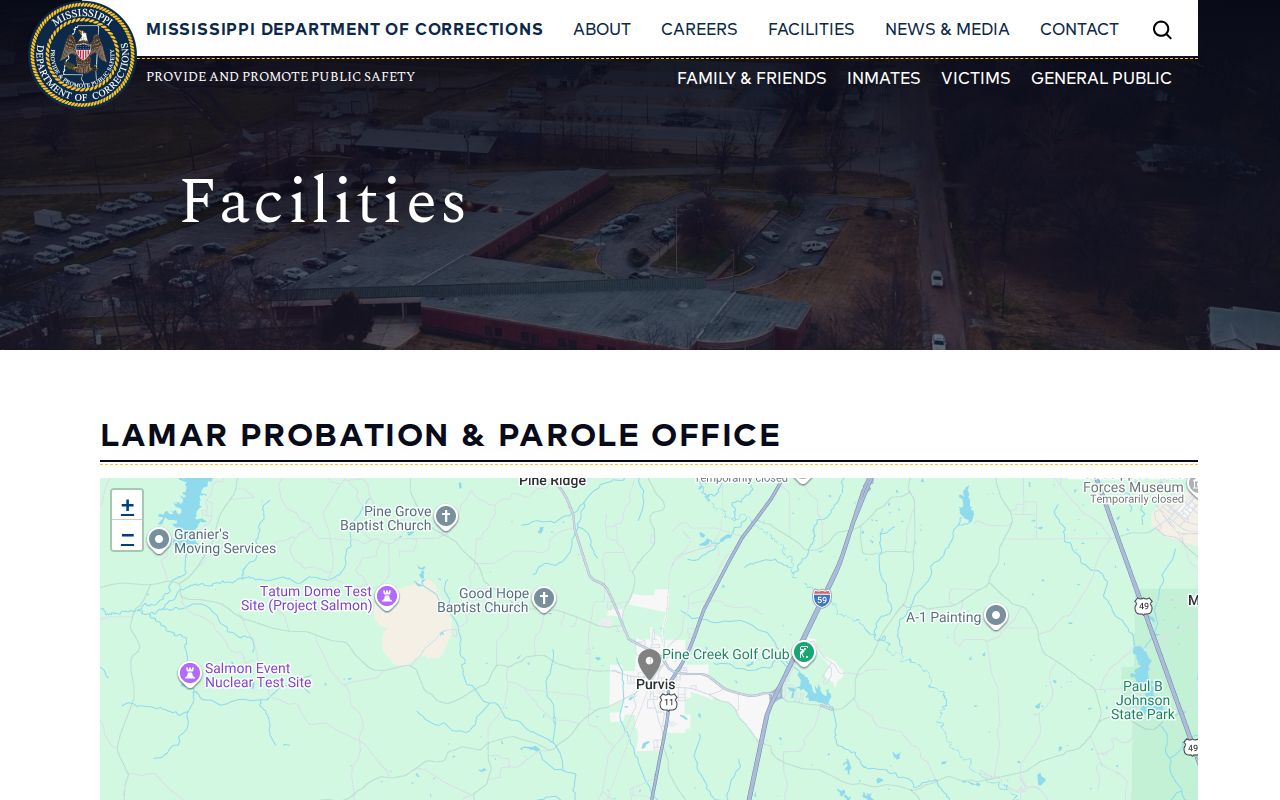
The captured office page helps distinguish community supervision in Purvis from confinement at the Lamar County Jail.
Lamar County Parole Decision Records
The State Parole Board decides Lamar County parole matters, while MDOC Community Corrections performs supervision after release. No official current person-level public hearing calendar or decisions search was found. The parolee search must not be treated as a Board decision database. Mississippi law supplies person-specific timing instead: under Miss. Code § 47-7-3, a tentative hearing date is determined after MDOC assumes custody, and the Lamar County hearing is generally placed near the eligibility month, subject to the statute.
Request the actual record when a decision matters. Give the person’s full name, MDOC number, and hearing or eligibility month, then ask for the existing notice, Board action, minute, or decision. A grant may still be followed by residence-plan review and release processing. It does not show that the person walked out on the action date. A denial or setoff also does not establish the maximum release date. Present custody must be checked after any expected action.
The Board directory lists 239 N. Lamar Street, Suite 501, Jackson, MS 39201 and telephone numbers 601-576-3520 and 601-576-3528. Historical Board records from 1942 through 2009 are cataloged by the Mississippi Department of Archives and History, but that catalog is not a current calendar.
Note: A hearing outcome and a physical release are different events, so use the Board record and the MDOC status record together.
Lamar County Absconder Status
Absconding is not release from supervision. It means the person is alleged to have stopped reporting, left an approved area, or otherwise become unavailable to the supervising agency. A warrant or return-to-custody process may follow. Lamar County did not publish a verified local absconder or supervision-warrant list during the research sweep. Avoid drawing that conclusion from a missing parolee-search entry.
MS SAVIN/VINE can send an abscond-supervision or return-to-custody event when a participating agency supplies it. Such an alert is a lead, not the full legal record. Read the named agency, event, and time, then confirm with MDOC, the Board, or the court that issued the warrant. A person can also leave the public parole registry because supervision ended, the reporting location changed, or the person is in a category not covered by that search.
High-level conditions may require reporting, approved residence, lawful conduct, and compliance with the specific order. The order controls. Public verification should focus on current status, a filed warrant or revocation order, and the final agency action rather than private supervision discussions.
Property After Lamar County Release
A distinctive Lamar County record concerns personal materials after a jail release. The official jail handbook dated 2018 states that a released person could use SmartJailMail credentials to download scanned photos, messages, and postal mail. It also describes outside property pickup through a property-release form. Those steps serve the former inmate’s own access needs. They are not a public parole, probation, or inmate search.
The handbook is dated, so the current process should be confirmed with Lamar County Jail at 601-794-1088 or the property officer route at 601-794-3562. Vendor access, account rules, and pickup practice may have changed. A property form also does not prove final discharge from supervision. It only documents handling of belongings or personal account material after the county custody event.
This distinction matters when reconstructing a timeline. The jail release sheet can establish the end of county custody. SmartJailMail or property pickup may show a post-release task. A parolee record can show current conditional supervision. Only the court, Board, or MDOC discharge record establishes the formal end of the supervision term.
Note: Verify the historical handbook procedure before travel because a former inmate’s property access may now use a different vendor or schedule.
Lamar County Supervision Discharge
Physical release, community supervision, and final discharge form three distinct milestones. The first ends confinement at the releasing facility. The second places the person in the community under parole, probation, ERS, or post-release rules. Final discharge ends the supervision term through the Board, sentencing court, or other lawful process. A person may therefore be released but not discharged.
Miss. Code § 47-7-40 provides earned-discharge credits for qualifying compliant people on probation, parole, or post-release supervision. When time served plus applicable credits satisfies the term, the Board or sentencing court enters the final action. Eligibility and calculation depend on the actual term and current law. Do not estimate discharge by adding dates from a public screen.
For present parole, use the parolee search. For probation or post-release supervision, inspect the judgment and contact the correct Community Corrections office. For historical proof, seek the existing final discharge order or agency record. The broader Lamar County released inmate search explains how a county custody record, court disposition, and state record fit together without confusing release from jail with the end of state control.
A registry entry may disappear when parole or flat time ends. That absence is consistent with the statutory removal rule, but it is not a substitute for the discharge document. The record is the proof.