
Lamar County VINELink Coverage
Mississippi brands its service MS SAVIN and provides the public search through VINELink. The system receives electronic custody changes from participating county and state agencies. Officially described events include release from custody, transfer, rehousing or temporary movement, escape, absconding supervision, return to custody after absconding, and other status changes. Those event types are broader than “released to the community.”
The research sweep did not locate a separate official statement confirming Lamar County participation. The live search must show whether a particular Lamar booking is available. If it is, the result can help follow that person’s current event trail. If it is not, the absence proves little about present or past custody. Lamar County Jail’s current roster, its release or transfer entry, MDOC records, and court orders remain the direct records for their own systems.
MS SAVIN is useful for Lamar County one-person checks and future notices. It is not a permanent Lamar County released-inmate archive. No fixed public retention period is promised, and an event record is not a certified discharge sheet.
Search Lamar County VINELink Records
Open the Mississippi VINELink interface and choose Search, then People. Enter the Lamar County person’s last and first name or an offender identifier if the current form offers it. Search narrowly. The purpose is to locate one person, not create a list of unrelated records. When several Lamar County names match, do not choose by name alone.
Open the candidate detail and compare all available identity and custody facts. The contributing agency or facility is crucial. Lamar County Jail points to a county booking, while an MDOC location points to state corrections. Read custody status with the event wording and date. A person can drop from Lamar JailTracker because of transfer, so an MDOC or other custody event may show continuing confinement rather than freedom.
- Open Mississippi’s state interface and select the People search.
- Enter the specific person’s name or offered offender identifier. Use complete, accurate spelling.
- Review each possible match and compare agency, facility, identity details, and status.
- Open the matching record. Read the event as written, especially whether it describes release, transfer, or another movement.
- Record the access time and contact the named agency when the event needs confirmation.
The broader Lamar County released inmate search explains which record to use when the person’s last custody system is unknown.
Note: A name-only match can identify the wrong person, so compare the facility, agency, identifier, and other available facts before acting.
Lamar County VINELink Release Fields
A Lamar County VINE detail is oriented to identity, agency or facility, custody status, and the event information supplied by the participating source. Exact prompts and fields can evolve. The official research did not support a promise that every Lamar County result contains the same release date, history, or identifier. Treat the screen as a time-stamped status view and read the named contributor closely.
| Field or signal | What it can establish |
|---|---|
| Name and identifier | Helps separate the intended person from similar names |
| Agency or facility | Shows which county or state system supplied the event |
| Custody status | States the current status known to the contributing agency |
| Release wording | Reports a VINE event, not a certified jail release sheet |
| Transfer or movement | Shows that location or custody may have changed without community release |
| Event time | Places the notice in sequence, subject to agency update lag |
Does “release” mean the person is free? Not always. Read the whole event and named agency. A county system may record release from its custody when another agency receives the person. The jail transfer record identifies the receiving destination.
Register Lamar County Release Alerts
After opening the matching Lamar County record, use the notification or registration control. MDOC describes telephone, text, and email channels. The available choices may depend on the live interface and event source. Enter the Lamar County alert contact details carefully and complete each on-screen verification. When telephone registration asks for a PIN, create or enter it exactly as prompted and retain it so later calls can be acknowledged.
No fixed PIN length is supported by the current official description. Do not rely on old instructions that promise a set number of digits. The live prompt controls. Registration can be anonymous through the public system, and anyone may register. Direct victims of MDOC state offenders also have a separate Division of Victim Services/SAVIN request form, which should not be confused with the public VINELink flow.
- Confirm the person and contributing agency before selecting the notification control.
- Choose each offered channel needed, such as telephone, text, or email.
- Enter and confirm the destination address or number shown by the live form.
- Finish the displayed verification. Create a telephone PIN only if the current prompt requests one.
- Keep the confirmation and note which agency supplies the events. Update contact details when they change.
Mississippi describes these channels and event types on the official MS SAVIN notification page.
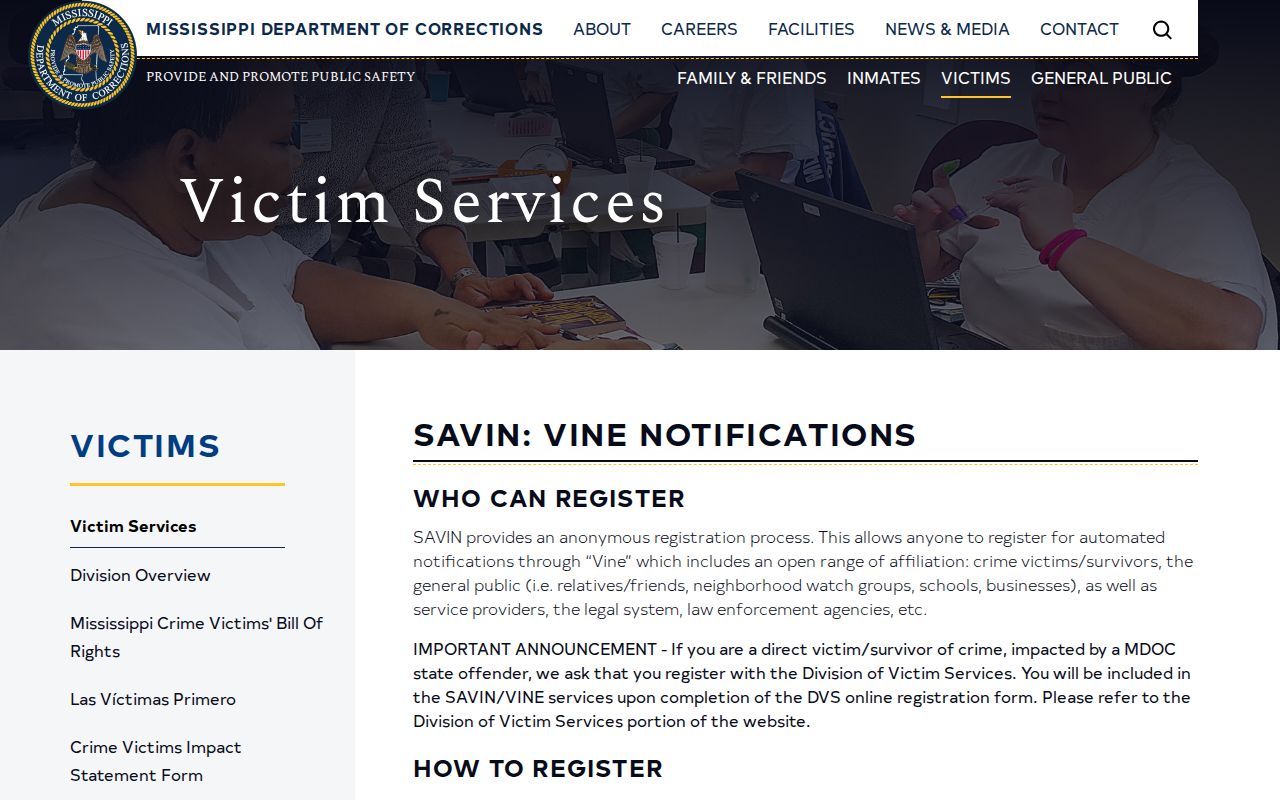
The captured state page supports the alert coverage and continuity rules while the live interface supplies the current registration prompts.
Lamar County Registration Link
MS SAVIN’s Registration Link is the distinctive local layer for a person moving beyond county custody. MDOC says a registration can follow a county-level offender into MDOC or “other custody” after a felony conviction. That continuity can preserve notices when the person disappears from Lamar JailTracker and enters a state or other participating system.
The same feature carries an important Lamar County warning. A county release event may be a transfer. If Registration Link continues with an MDOC event, the person may have left Lamar County Jail but remained confined. Read facility, agency, and status together. Then request the Lamar County release or transfer entry for the actual county exit and search the MDOC record for the new state location.
Multiple quick movements can create multiple notices. Rehousing, temporary movement, transfer, release, absconding, or return to custody are not interchangeable. Preserve the sequence and confirm the last event with the agency named in it. A VINE event is valuable notice, while the jail, court, MDOC, or receiving-agency record supplies the durable proof.
Note: Registration Link continuity is most useful when it prevents a transfer from being mistaken for release into the Lamar County community.
Confirm Lamar County VINE Alerts
After an alert, first identify the source agency and exact event. For a Lamar County Jail event, call the jail at 601-794-1088 and ask whether that booking ended in community release or transfer. Request the actual date, time, type, and destination from the existing release or transfer entry. If MDOC is named, open the state offender detail and compare Location, Unit, and status.
MS SAVIN offers Lamar County confirmation help through the Office line at 601-359-5759 during standard business hours, 24-hour English and Spanish help at 1-888-9-MSSAVIN, and TTY assistance at 866-847-1298. These routes can help interpret a Lamar County notice or resolve a registration issue. They do not replace the legal and custody records held by the contributing agency.
A released result may later disappear because VINE is not a guaranteed permanent archive. Preserve the relevant jail sheet, court order, state discharge record, or receiving-agency record when historical proof matters. If an event involves a state tentative date, remember that the date was a projection until actual status changed.
Lamar County VINELink Limits
Federal and immigration custody require separate tools. The Federal Bureau of Prisons locator covers federal prison records and can show a released date or “Not in BOP Custody.” That wording does not rule out custody elsewhere. ICE’s locator covers immigration detention using its own search fields, and U.S. Marshals custody may require the federal court docket or a records request until BOP designation occurs.
County jail, state prison, and federal release records also answer different questions. Lamar JailTracker is a current county roster. The jail’s release sheet records the county exit or transfer. MDOC’s inmate search describes state corrections status and may show a tentative date. The parolee search concerns current state parole. VINE supplies event notices from participating sources. None should be renamed or stretched into a universal custody history.
Older Lamar County events call for records that last beyond a live alert. Ask the jail for the existing booking, custody, release, or transfer sheet tied to a specific person and booking. Ask the court for the bond, dismissal, judgment, sentence, or revocation order that gave legal authority. If state corrections was involved, request an existing offender data sheet, sentence computation, release notice, or discharge record. These sources preserve different facts and can be compared without assuming that VINE retains a full history.
Timing also matters. A notice may arrive after staff enter or transmit a change, not at the exact moment a person crosses a facility exit. Several rapid movements can generate alerts close together. Record each message, its named agency, and its event time, then ask that agency for the completed entry. When the last event is a transfer, continue with the receiving system. When it is a community release, the release sheet and any supervising order describe what followed.
Use VINELink for a specific Lamar County person and a future alert. Use the originating record for proof. That division keeps a transfer, a projected date, a parole status, and a completed community release from being confused.